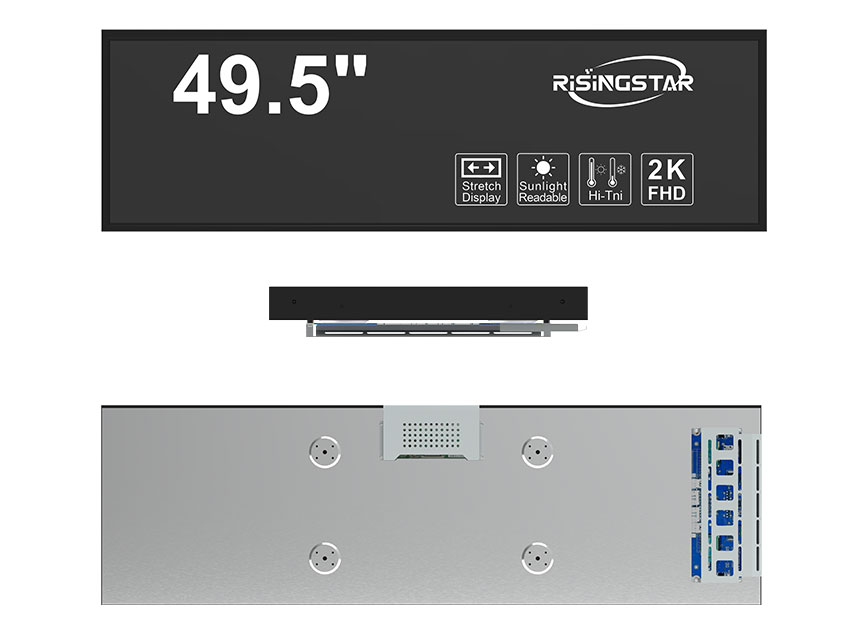
In today’s increasingly mobile and outdoor-focused industrial, military, and transportation sectors, the demand for reliable, high-brightness LCD screens that remain visible under direct sunlight has never been higher. Whether it's a ruggedized tablet in a construction site, a vehicle dashboard in extreme heat, or a medical device used in emergency response, the performance of the display directly impacts safety, efficiency, and user experience. This article explores the engineering principles, manufacturing techniques, and real-world applications behind sunlight-readable, high-brightness LCD screens—offering actionable insights for engineers, procurement managers, and product designers.
Why Sunlight Readability Matters
A standard LCD screen typically operates at 250–300 nits (candela per square meter) brightness—a level sufficient indoors but inadequate under bright daylight. In contrast, sunlight-readable displays must achieve 1000 to 5000 nits, depending on application. For example, the MIL-STD-3009 specification for military-grade displays mandates minimum brightness levels ranging from 1000 to 4000 nits, with full visibility even at noon sun. The key challenge lies not just in increasing brightness but also in maintaining image contrast, color accuracy, and thermal stability under harsh conditions.
According to a 2023 study by the Society for Information Display (SID), over 78% of outdoor electronic devices deployed in industrial environments fail due to poor display visibility—not mechanical failure or power issues. This underscores the importance of investing in robust display technologies from the design phase.
Core Engineering Principles
The foundation of a successful sunlight-readable LCD lies in three pillars: brightness enhancement, contrast optimization, and ambient light rejection.
1. Brightness Enhancement via LED Backlighting
Traditional CCFL (Cold Cathode Fluorescent Lamp) backlights are obsolete for high-brightness applications due to their limited output and energy inefficiency. Modern solutions rely on high-efficiency LEDs, particularly white LEDs with phosphor coatings that provide uniform illumination across the panel. Advanced systems use local dimming—where individual LED zones adjust brightness based on content—to maximize perceived luminance while minimizing power consumption.
For instance, a recent case study from Sharp Corporation demonstrated that using 2000+ LED zones in a 15-inch LCD reduced overall power draw by 30% while achieving 4000 nits peak brightness—an ideal balance for solar-powered field equipment.
2. Contrast Optimization through Anti-Reflective Coatings and Polarizers
Even with high brightness, poor contrast renders content unreadable in sunlight. A typical issue is glare caused by reflection off the glass surface. To mitigate this, manufacturers apply multi-layer anti-reflective (AR) coatings with refractive indices optimized for specific wavelengths. These coatings reduce surface reflectivity to less than 1%, enabling clearer visuals under direct UV exposure.
Additionally, advanced polarizer stacks—often incorporating nanostructured films—are used to improve contrast ratios beyond 10,000:1. Such polarization control ensures that only light aligned with the display’s axis passes through, reducing ambient light interference significantly.
3. Ambient Light Rejection Using Micro-Lens Arrays and Diffusers
One often overlooked aspect is how light from the environment interacts with the display. Without proper diffusion, stray light can cause “ghosting” or washout effects. To solve this, some manufacturers integrate micro-lens arrays (MLAs) between the backlight and liquid crystal layer. These tiny lenses focus emitted light toward the viewer while scattering ambient light away, effectively improving effective contrast by up to 3x.
This technique was successfully implemented in a collaboration between LG Display and NASA for space mission control interfaces, where ambient lighting conditions vary dramatically—from total darkness to full solar irradiance.
Manufacturing Considerations
While design dictates performance, manufacturing determines scalability, consistency, and cost-effectiveness. Key steps include:
- Panel Selection: Use IPS (In-Plane Switching) or AHVA (Advanced Hyper View Angle) panels for wide viewing angles and superior color reproduction. TN (Twisted Nematic) panels may be cheaper but lack the necessary viewing quality for professional use.
- Backlight Assembly Precision: Each LED must be placed within ±0.1 mm tolerance to avoid hotspots or dark spots. Automated optical inspection (AOI) systems are essential during assembly to detect misalignment early.
- Thermal Management: High-brightness operation generates significant heat. Designs must incorporate passive cooling methods like aluminum heat sinks or active solutions such as miniature fans, especially for devices operating above 50°C ambient temperatures.
- Environmental Sealing: Dust, moisture, and vibration are common in outdoor environments. IP65 or higher ratings should be standard. This includes using sealed edge seals, conformal coatings on PCBs, and shock-absorbing mounts.
Industry leader Panasonic’s 2022 white paper highlighted that 65% of failures in outdoor displays stemmed from inadequate sealing rather than display components themselves—underscoring the need for holistic system-level design.
Real-World Applications and Case Studies
1. Military Field Command Units
In joint exercises conducted by NATO forces in 2023, units equipped with 4000-nit sunlight-readable displays reported 92% faster target identification compared to older models. These displays were tested under simulated desert conditions with ambient light exceeding 10,000 lux. The success was attributed to integrated AR coatings and dynamic brightness adjustment algorithms.
2. Medical Emergency Devices
During the 2021 pandemic, hospitals in India deployed portable diagnostic tools featuring 2500-nit displays. These devices enabled paramedics to read vital signs clearly under open-air tents or moving ambulances. The key innovation was a hybrid backlight system combining RGB LEDs with a diffuser that maintained color temperature consistency—even when battery levels dropped below 20%.
3. Transportation and Automotive HUDs
Automotive OEMs like BMW and Tesla now offer head-up displays (HUDs) with 3000+ nits brightness. These are not just luxury features—they enhance driver safety by reducing eye movement. A 2022 report from SAE International found that drivers using high-brightness HUDs had 17% fewer reaction delays in low-light-to-sunlight transitions.
Standards and Compliance
Adhering to international standards is non-negotiable for any serious manufacturer. Critical certifications include:
- MIL-STD-810G – Environmental durability testing for shock, vibration, temperature extremes
- IP65/IP67 – Dust and water resistance for outdoor use
- IEC 60950-1 – Electrical safety for consumer electronics
- EN 55032 – Electromagnetic compatibility (EMC)
These standards ensure interoperability, safety, and long-term reliability in demanding environments.
Future Trends and Innovations
Looking ahead, several breakthroughs are reshaping the landscape:
- Mini-LED and Micro-LED Displays: Offering higher brightness (>5000 nits) and better local dimming than traditional LED-backlit LCDs.
- Quantum Dot Technology: Enhancing color gamut and efficiency, particularly in high-end medical and defense applications.
- AI-Powered Brightness Adjustment: Real-time adaptive algorithms that optimize brightness based on ambient light, user proximity, and content type—reducing power consumption without sacrificing readability.
A prototype developed by Samsung Display in Q1 2024 achieved 5000 nits with 90% lower power usage than previous generation LCDs—a game-changer for battery-powered devices.
Conclusion
Designing and manufacturing sunlight-readable, high-brightness LCD screens is both an art and a science. It requires deep understanding of optics, materials, thermal dynamics, and real-world operational constraints. By prioritizing brightness, contrast, and environmental resilience—and adhering to industry standards—engineers can create displays that perform reliably across diverse global environments.
Whether you’re developing a ruggedized handheld device, a vehicle infotainment system, or a critical medical tool, choosing the right display technology isn’t optional—it’s foundational to product success.